Monday, February 23, 2015

Utterly Disturbing, Century-Old Photos of Meat-Packing Facilities

Gabrielle Williams

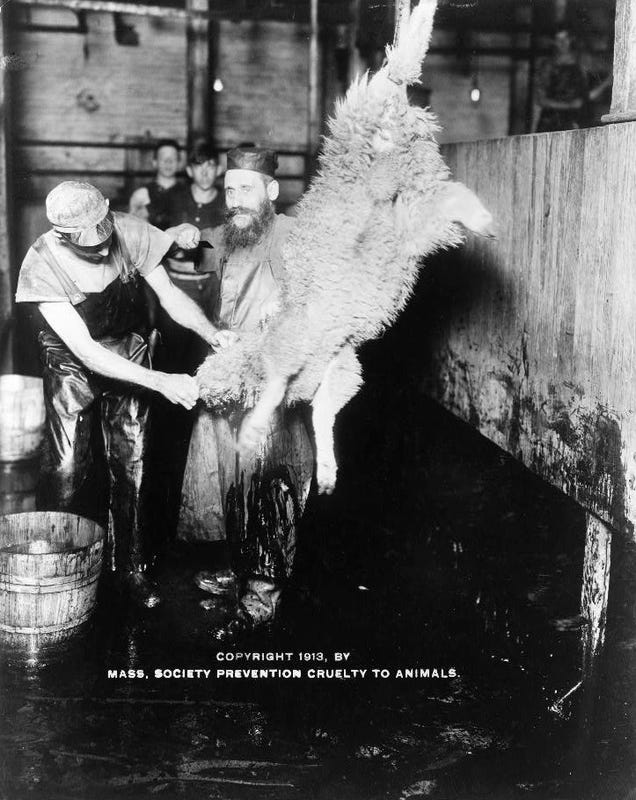
Pools of blood, stale water, rotting meat; it sounds like something out of a horror movie. Unfortunately, it was the reality of the meatpacking industry in the early 1900's. Although some people today believe conditions in the food industry, specifically the meatpacking industry to be grotesque, it cannot compare to the horrid conditions found in the early 1900’s. Many of these conditions were exposed in the well known book “The Jungle” by Upton Sinclair. Up to that point , the people of the United States were not incredibly concerned or educated on the happenings in the meatpacking industry. “The Jungle”, however, helped to change all that.
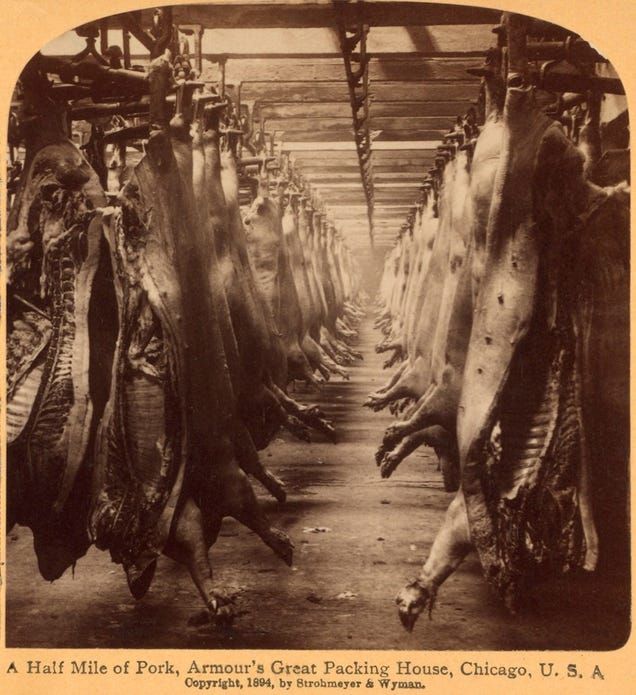
Utterly Disturbing, Century-Old Photos of Meat-Packing Facilities In the early 1900’s, conditions in the meatpacking industry were dangerous not only for the consumers but also for the workers. There were many potential hazards in the industry such as back injuries, knife cuts, infections, and falls. These hazards are still present today but are much less common that in the early 1900’s. Although “The Jungle” was supposed to be a novel recognized for the hardships in the United States for immigrants, readers were more appalled by the conditions of the meat factories. Sinclair visited meat factories in order to gather information for his book. The fact that the information provided in the book was a first hand account startled readers. Soon, rumours began to spread about people being caught in the machines only to be grounded up along with the rest of the meat. Immigrant men were usually in charge of the hard work. They worked in dark, unventilated rooms that were sweltering in the summer and freezing in the winter. They stood on their feet throughout the day in pools of blood, scraps of meat and stagnant water. Women and children who were over a certain age canned meat, trimmed, and made sausages. Nearly every part of the animal was used. The meat was canned, pickled, salted, smoked, etc. All of the other parts ended up as fertilizer or lard. Meat was shoveled into carts to be packaged and as men shoveled, they would often find rats inside of the meat. Instead of deeming the meat unfit for human consumption, they picked them out and continued on with the shoveling. There was no place for people to wash their hands and so they washed their hands in water that was to be put in with the sausages. This, obviously, further contaminated the already disgusting water. All of the sausage that was made was of the same quality but the workers would set some randomly aside and mark it as “special” and charge more for it. Meat was taken to be processed in barrels full of dirt, old nails, and rust. This is the meat that they were serving to the unknowing public.
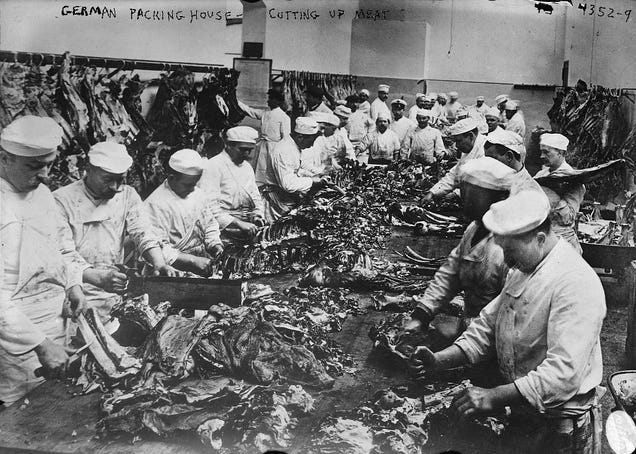
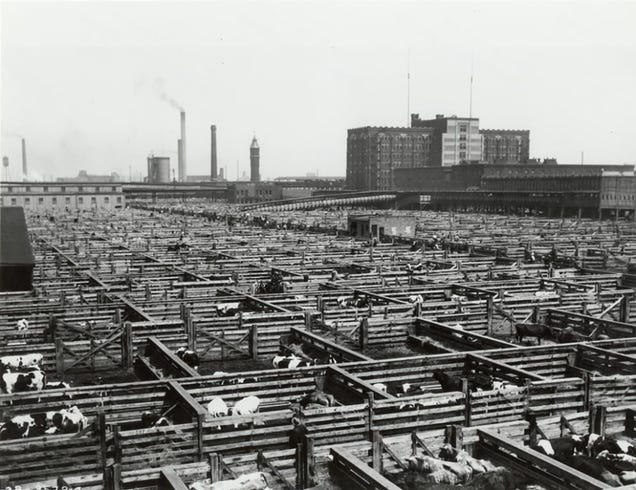
Utterly Disturbing, Century-Old Photos of Meat-Packing Facilities

Utterly Disturbing, Century-Old Photos of Meat-Packing Facilities After the public read “The Jungle”, the White House received a plethora of mail concerning the condition of the meatpacking industry. The people demanded that the president change the way it functioned. Up until that point, the inspection process for meat was subpar. Inspectors were only required to make sure the animal that was being killed was healthy at the time of it’s death. In “The Jungle”, the fact that rotten meat was being “freshened” with chemicals and sold under false pretenses to the American public became widely known. When investigating the claims that Sinclair made, a commission made by the White House found that the astounding number of claims he made were, in fact, true. While investigating, they witnessed part of a pigs carcass fall into one of the workers toilets. Instead of discarding the tainted meat, they simply plucked it out of the toilet and continued to go about the process of cutting it into meat for the public.
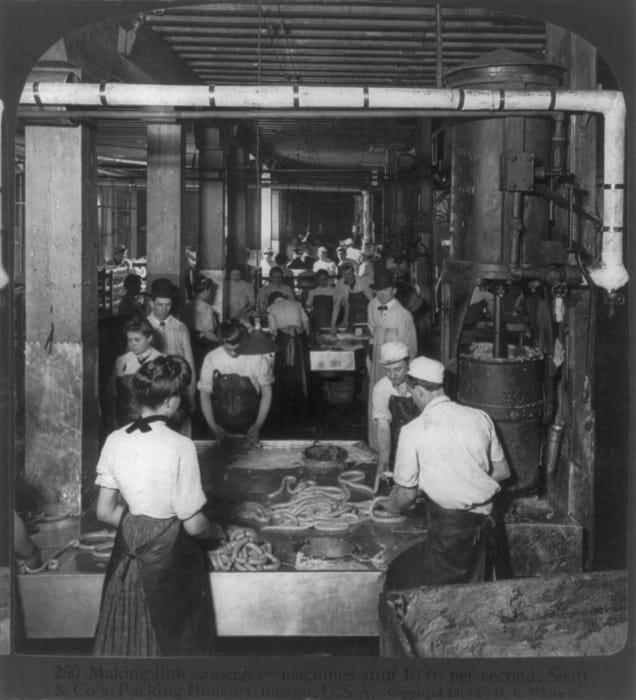


Utterly Disturbing, Century-Old Photos of Meat-Packing Facilities Because of public outcry and the investigation, President Roosevelt decided to put a change to the way the meatpacking industry was run. On June 30, 1906 he signed the Meat Inspection Act. On that same day, he signed a law that said that food and drugs were required to be regulated. It was due to this that the meatpacking industry was finally regulated and began to become closer to what we know it as today. Although many of us still do not consider it to be extremely safe or sanitary, it is a stark improvement from it’s previous conditions. There was a saying in the meatpacking industry that went “we use everything except the squeal.” It is a definite relief “The Jungle” was written and the public reacted the way they did or else this saying would still be applicable today, which would really be something to squeal in horror about.


Works Cited
"Conditions in Meatpacking Plants (1906, by Upton Sinclair)." Dictionary of American History. 2003. "Conditions in Meatpacking Plants (1906, by Upton Sinclair)." Encyclopedia.com. HighBeam Research, 01 Jan. 2003. Web. 23 Feb. 2015.
"Meat Packing - IHT 13:2 2006." Meat Packing - IHT 13:2 2006. N.p., n.d. Web. 23 Feb. 2015.
"Packing and Processing." The United Food and Commercial Workers International Union UFCW. N.p., n.d. Web. 23 Feb. 2015.
"Safety and Health Guide for the Meatpacking Industry." Safety and Health Guide for the Meatpacking Industry. N.p., n.d. Web. 23 Feb. 2015.
Sinclair, Upton. The Jungle. N.p.: n.p., n.d. Web.
"Upton Sinclair's The Jungle:Muckraking the Meat-Packing Industry." BRIA 24 1 B Upton Sinclairs The Jungle: Muckraking the Meat-Packing Industry. N.p., n.d. Web. 11 Feb. 2015.

"Utterly Disturbing, Century-Old Photos of Meat-Packing Facilities." Io9. N.p., n.d. Web. 23 Feb. 2015.






Birth Control

Logan Rogers
January 23, 2015
US History
Progressivism

Birth Control and How It Affected the US during the Progressive Era
Birth control is a widely used device in modern day society whether it is used to protect one from getting STD’s or not having a child. People buy this on a regular basis and most don’t think about whether or not it is immoral to do so. During the Progressive Era, contraceptives were illegal. So if someone had sex and didn’t want a kid their pull out game better be strong or else they have themselves a baby. During this time of progressivism, there were many factors to determine if things of such nature were immoral or not and Margaret Sanger did exactly this herself.
Margaret Sanger
In 1914 Sanger left for Europe to study the movement of the legality of birth control. These travels were the result of her challenging the government for the legalization of birth control. Sanger went to England and studied the birth and death rates in Europe and found Holland to stand out to her. In January 1915 Sanger visited Dr. Rutgers and he suggested that she look into the mensinga pessary. This was not the only contraceptive used, while there she found over 15 devices used in contraception. Rutgers trained other nurses in hygienic methods of family limitation. They did this so they could open other clinics in places other than The Hague, the location for the government in Holland. Sanger mentioned in her paper that “I would wander about the city looking into shops where supplies were sold, which at that time carried window displays.” She spent hours studying in the Central Bureau of Statistics. She had gotten the data of Holland for things such as birth and death rates, infant mortality, true or false fertility, child labor, and wages. During her research there, she found that the contraceptives were benefiting the society in a positive way. While most people would use contraceptives, Holland tried to teach the family
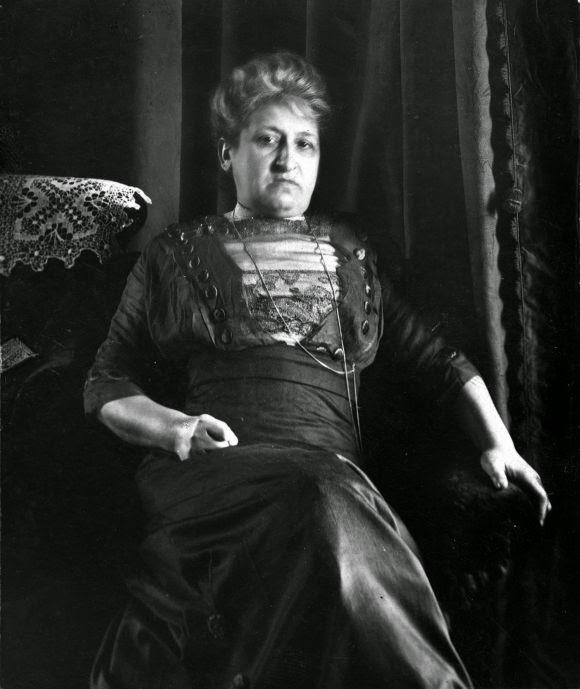
Dr. Aletta Jacobs
limitation practice in places of poverty or disease. Sanger tried talking to Dr. Aletta Jacobs, the first woman doctor in Holland. Sanger sent a letter to interview Dr. Jacobs but she was denied because jacobs didn’t want part in her laymen studies and thought that it was only for doctors and “only professional men and women should take it up”.
Typical sized Irish family
        Sanger’s main goal was to find the one contraceptive to keep women from having to deal with the pain from constant and unwanted pregnancies. She started this movement because of the loss of her mother. Her mother died of TB at the age of 50 years old. Sanger was one of eleven children from an Irish catholic family. She was at her mother’s funeral in front of her coffin next to her dad when she yelled at her dad with “you caused this. Mother is dead from having too many children.” Sanger didn’t want to follow in her mother’s footsteps so she fled north to become a nurse and eventually found a job in NYC as a visiting nurse. That is
when she saw that her mother’s tragedy was completely real and most among the poor immigrants. Most women there who were having unwanted pregnancies would resort to “back alley five dollar abortions” (PBS). After she worked with that, she decided to change from nursing to a researcher to legalize contraceptives so she could stop all of the mental degradation and physical instability from these abortions for unwanted babies.
        The eugenics movement had a lot to do with people and their traits/genetics and whether or not their offspring would be smart or intelligent enough in the future. This was rather controllable until people immigrated to the US. They were immigrants in which we didn’t know their history or backgrounds as well as we knew our own. With this problem, we found out that the quality of the person went down because we had a language barrier, skill set barrier, and people also had a problem with the immigrants and their children looking different than them. An extensive study including Senator William P. Dillingham of Vermont determined that the new immigrants were not as well suited as the earlier immigrants were. They weren’t suited in the sense that they were not smart enough, strong enough, or didn’t meet the correct specifications for jobs. They figured the immigration was “contributing to the multiplication of the unfit” (586, Brinkley). Some people realized they needed to do something about it and so they created different types of contraceptives.
Different sized cervical caps
        The two main types of contraception besides the condom and before the pill was invented were the diaphragm and the cervical cap.  The diaphragm is a dome made of soft and thin rubber. This does a very good job at keeping the sperm out, however the female must use a spermicide with it aswell. A cervical cap is pretty much the same except that they have to be able to find their cervix without a problem because the caps fits like a soda can koozie rather than the looser fitting diaphragm. These methods of contraception were not highly used because they, to correctly protect the individual, needed to be sized and most people couldn’t afford doctors to do so since it was illegall . If a woman were to try and use one of these methods, they were more than likely to fail back then because they were unskilled when putting it in.  These methods were very useful as a contraceptive, but most people did not know how to use these devices correctly so it would fail them. This would lead to unwanted pregnancies and then abortions.  They realized that this wouldn’t work for them so they later created the, now highly protective and useful, condom. Despite their importance to society they were still illegal and appropriate actions had to be taken for such things even if it was just the spreading of the news for these new contraceptives.
Anthony Comstock
         The Comstock law was a law that made it illegal to send unsightly objects through the mail systems. This law includes the sending of information contraceptives also. Since the news about these news devices had to be shared, it had to be sent out to the people. People would read about the different types of contraceptives through literature in the mail. This was unlawful. According to The Christian Record,  a man was “arrested here yesterday on the charge of printing and circulating immoral literature through the mails.” The printing of this sort of news was not legal at the time because it considered immoral and wrong.
Early  illegal birth control clinic
      Margaret Sanger was the one to study and research about what is immoral and what isn’t during the progressive era and she was finding out what that really meant. During this time of creating contraceptives and the process of Sanger opening up birth control clinics, she had been put in jail for 30 days at one point and she also kept re-opening her clinics when she got out of jail and kept getting arrested. Now that contraceptives are not illegal birth control clinics are places that are now widely used and are essentially in every store. These contraceptives are so accessible and easily used that anyone could by them. But, is it morally correct to allow young teens to having sex? 


Sources:

Thompson, Kristen M.J. "A Brief History of Birth Control in the U.S. - Our Bodies Ourselves." Our Bodies Ourselves. Our Bodies Ourselves, 14 Dec. 2013. Web. 11 Feb. 2015.
I used this source by taking the information about what margaret sanger did and looking it up through google to find scholarly sources. I believe this is a credible source because i was able to check this information with other sources. Thompson was trained at the John Hopkins school of Public Health. She is now the project manager at the university of California, san francisco, Bixby center for Global reproductive health.

Sanger, Margaret, Mrs. "MY EXPERIENCES IN HOLLAND." The Public Papers of Margaret Sanger: Web Edition. NYU, Web. 09 Feb. 2015.
This is a credible source because they are first hand written works from Margaret Sanger’s public papers. Margaret Sanger was a researcher for birth control. She was trying to get birth control legalized and did extensive research on it also.


PBS. "The Pill." PBS. PBS, Web. 11 Feb. 2015.
This is a strong and credible source because it comes from the Public Broadcasting Service and they are nationally renowned for being honest and truthful. This is helpful for my research because it talks about margarets sangers life before she started moving into the studies of birth control. I will be able to use this to my advantage because I can use her personal life to explain her first hand information from research in Holland.


Delvin, David, Dr. "Contraception – Diaphragms and Cervical Caps." Netdoctor. Netdoctor, n.d. Web. 20 Feb. 2015.
This is a strong and credible source because this a medical study about contraceptives. I will use this to explain why this was not a very effective mode of contraception in the period in which they were illegal. Dr. Delvin is a general Practitioner and family planning specialist. He knows how contraceptives are supposed to work correctly. I can use that data against other laws and acts in place at the time of margaret sanger to come to a conclusion of why things happened the way they did.


"Items of State News." The Christian Recorder [Philadelphia] 23 Aug. 1894: n. pag. Accessible Archives. Web. 21 Feb. 2015. http://www.accessible-archives.com/2011/03/federal-comstock-law-passed-1873/
This is a strong and credible source because this a medical study about contraceptives. I will use this to explain why this was not a very effective mode of contraception in the period in which they were illegal. Dr. Delvin is a general Practitioner and family planning specialist. He knows how contraceptives are supposed to work correctly. I can use that data against other laws and acts in place at the time of margaret sanger to come to a conclusion of why things happened the way they did.


Brinkley, Alan. "21 The Rise of Progressivism." American History: A Survey. Boston: McGraw-Hill, 2007. N. pag. Print.
This source is a secondary source and very trustworthy because we use it for class everyday. It has very good information on immigration at the time of progressivism and eugenics and how that had a play in population.


"History of Contraception-Cervical Caps and Diaphragms." History of Contraception-Cervical Caps and Diaphragms. Case Western Reserve, n.d. Web. 23 Feb. 2015. http://www.case.edu/affil/skuyhistcontraception/online-2012/Cervical-Caps-Diaphragms.html 
I will use this source to learn about the history of contraceptives as a whole. This is a credible source because it is a university and made for students to use for research. This teaches me the history and how it has affected the  US as a whole.


American Medical Association

The American Medical Association was founded by Nathan Davis Smith at the Academy of Natural Sciences in 1847. There were two hundred and fifty delegates from about twenty eight states that had attended the founding meeting. Nathan Smith Davis was called the founder because of his resolution to the New York Medical Association which wanted a national medical convention. 
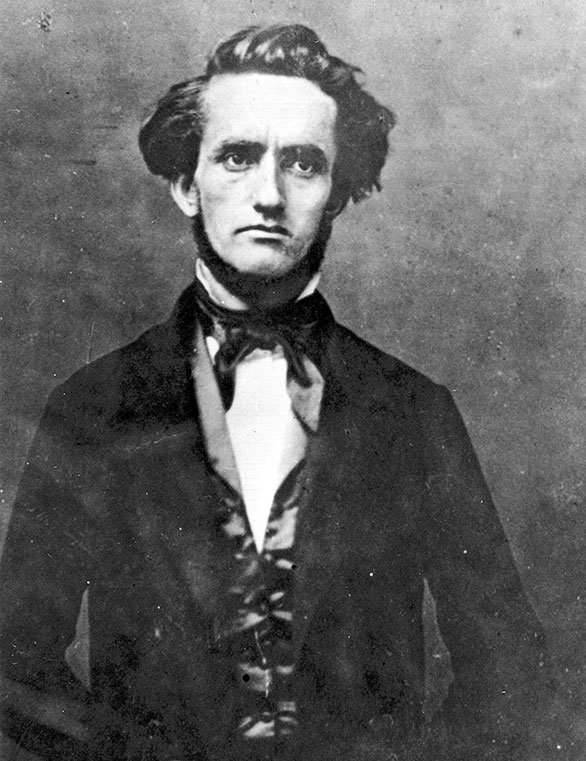
The founder Nathan Smith Davis


Ever since the creation of the AMA it has long supported the ideas for improved public health, scientific advancement, and the interactions between doctors and patients. The AMA has goals of advancing science, having standards for medical education and launching a program for medical ethics. They also feel that regardless of race and age, every citizen of the U.S. should have a fair and equal chance of medical care.
The founding of the AMA at the Academy of Natural Sciences


Nathan Smith Davis was only 30 when he founded the AMA. He received his medical training at the Medical College of Western New York and through multiple different apprenticeships with individual physicians. Mr. Davis had later been elected into the New York Medical Society and during his election he worked to improve medical education and license. Also during his his time serving at the NY Medical Society he brought up the resolution of  creating a national medical association. By mid civil war Davis had been elected as the president of the AMA and was named the first editor of the Journal of the American Medical Association. 
The outside of the Academy where the AMA was founded


The founding of the AMA was during the time of great change in modern medicine. There were many rapid advances in science as well as new approaches by physicians. One of the more prevalent techniques during this time was the use of anesthetics and antiseptic or aseptic operating areas. The AMA had recommended and pushed for using these agents in medicine. But there were not completely sure in using them in surgery or obstetrics yet. 
An operation room with
There were many documents that were created by the American Medical Association so that there could be organization and standards to the medical field. One of the most important document made by the AMA was the AMA Code of Medical Ethics. It was adopted by the AMA committee during the founding meeting and is basically the guidelines that all doctors need to follow in order for them to become professionals. It has been the authoritative guide on medical professionalism for more than 165 years. Through its creation it was the first nationwide standard for preliminary medical education and the degree of MD. 
The front of the Code of Medical Ethics by the AMA


Before the founding of the AMA there were not too many standards for anything in the medical area. Almost anybody could operate on you and they would not need any certification. There were more medical deaths before the AMA, and the patient doctor relationship was not very good. Many people were often scared of going to the doctor and would not go unless it was an absolute emergency. Even though there were family doctors it didn't mean that the doctor would be able to take care of the family, especially if the medical operation was in the house of the patients. 


"Our Founder, Nathan Smith Davis." Our Founder, Nathan Smith Davis. N.p., n.d. Web. 23 Feb. 2015.


Eugenics Movement in America- Drew Hoyt

Drew Hoyt
The Eugenics Movement in America
            When the word “Eugenics” arises in any conversation, it is not hard to deduce where the minds of American listeners likely go: the infamous holocaust in Nazi Germany in the 1930s-40s. What many Americans likely don’t know, however, is that the US were actually pioneers in the Eugenics movement, with the movement in America even predating the more well-known movement in Europe. Eugenics, or the improvement of the human race through sterilizations or selective breeding, was quite prevalent in the US. 32 American states passed eugenics laws in the early 1900s, beginning in Indiana and even including our state, Alabama.
A medal awarded in a contest for "Fitter Families"

In many ways, the eugenics movement in America was founded from ideals that we have already studied, namely Social Darwinism. Social Darwinism, the idea that society is similar to nature in that the “most fit” people would survive and continue the human race, had already factored heavily into the United States’ role in the imperialism era, and the US citizens’ point of  view on imperialism. In the early 20th century, the ideals of social Darwinism were more prevalent than ever, and they were being used to justify something much different: the Eugenics movement. By the logic of Eugenics supporters, if someone (in their opinion) wasn't fit enough to give birth to and raise a fit child, they should not be allowed to have children.
Winners of a Fitter Family contest
This idea gave rise to something quite frightening: sterilization. In 1907 Indiana passed the first sterilization law, and between then and 1928, nearly 30 states had followed suit. These laws allowed compulsory sterilization of those the state deemed unworthy of having children. These included “imbeciles” or people the state deemed insane, and epileptics. These sterilizations, although morally wrong by almost any definition, were condoned by the majority of American citizens. This is, perhaps, because of the perception that the American family was in danger, for the US had the highest divorce rate in the world. Americans wanted to save their precious idea of the American family, and eugenicists promised to do just that.
An illustration which shows many of the main tenets of the eugenics movement
            This idea of a perfect American family was never more prevalent than in the fitter family contests of the early 1900s. In these contests, families would be judged similarly to livestock, based on which family was more physically fit, healthy, and which family better embodied the idea of the model American family. It is no coincidence that these contests closely resembled the judging of livestock; it was another play by eugenicists to influence the American public. By utilizing this similarity to create a sense of nostalgia with the American public, eugenicists hoped to associate the movement with fond memories for Americans, and further ingrain their movement in the American mind.
Poster advocating for the sterilization of genetically inferior people
Charles Davenport, the Director of the Eugenics Record Office from 1910 to 1934, was a key figure in the movement. He was considered a “strict hereditarian”, believing that a human’s heredity was the most important factor in his traits and characteristics by far(Lovett 13). Under Davenport, the Eugenics Record Office collected and organized family pedigree data in order to better determine what made a “fitter” human. The combination of this research, and the American public’s desire to preserve their idea of a fit family, created the perfect political climate for the eugenics movement to flourish. ­The American Eugenics Society was another organization which took up a major role in the eugenics movement. They, however, “emphasized education and the promotion of eugenics in American society more than scientific research.” These two organizations were each major factors in the eugenics movement taking up root in the US.
Charles Benedict Davenport.jpg
Charles Davenport, director of the Eugenics Record Office

The Eugenics movement in the United States served as an example to many other countries, and was one of the fore-running countries of the idea. While the movement had mostly ended by the 1950-60s, sterilizations continued to occur, although more rarely, until recent decades. It is important for Americans to be aware of this movement, because for such a movement to happen again would be a terrible occurrence for the United States.


Works Cited
Kaelber, Lutz. "Eugenics: Compulsory Sterilization in 50 American States."Eugenics: Compulsory Sterilization in 50 American States. University of Vermont, 24 Mar. 2009. Web. 19 Feb. 2015. <http://www.uvm.edu/~lkaelber/eugenics/>. This source gives a good overview of the different sterilization statistics of each American state
"Eliminating the Inferior: American and Nazi Sterilization Programs: Institute for the Study of Academic Racism - Ferris State University." Eliminating the Inferior: American and Nazi Sterilization Programs: Institute for the Study of Academic Racism - Ferris State University. Ferris State University, n.d. Web. 20 Feb. 2015. <http://www.ferris.edu/isar/archives/eliminating-inferior.htm>. This source gives a good overview of the events of the eugenics movement in America, and is a good source for keyword for other searches.
"Eugenics." EveryBody: An Artifact History of Disability in America. Smithsonian National Museum of American History, n.d. Web. 23 Feb. 2015. <http://everybody.si.edu/citizens/eugenics>. This source features a collection of artefacts which serve as remnants of the eugenics movement, which allows a concrete look at the movement.
"Eugenics and the Church." New York Times n.d.: n. pag. New York Times Archive. New York Times, 05 Oct. 1913. Web. 23 Feb. 2015. <http://query.nytimes.com/gst/abstract.html?res=9B01E7DF1E3BE633A25756C0A9669D946296D6CF>. This article highlights the position of the church against eugenics, which will be crucial for me to highlight in my paper.
"The Duty of Society." New York Times 4 July 1913: n. pag. New York Times Archive. New York Times Company. Web. 23 Feb. 2015. <http://query.nytimes.com/mem/archive-free/pdf?res=9505E7DE163DE633A2575BC0A9619C946296D6CF>. This source highlights the view of eugenics supporters that their movement rose from mankind's "responsibility to society" to be eugenically conscious.
Saleeby, C.W. "The Sociological ReviewVolume A7, Issue 2, Article First Published Online: 19 AUG 2011." THE FIRST DECADE OF MODERN EUGENICS1. N.p., 2011. Web. 23 Feb. 2015. <http://onlinelibrary.wiley.com/doi/10.1111/j.1467-954X.1914.tb02375.x/pdf>. This gives a look back at the first decade of eugenics through the viewpoint of someone who is still going through the movement.
 Lovett, Laura L. "Fitter Families for Future Firesides." (n.d.): n. pag. Web. 20 Feb. 2015. <http://www.yale.edu/agrarianstudies/colloqpapers/19lovett.pdf>. This paper contains a good amount of information on Fitter Family contests, an important element of the eugenics movement in America

Conservation Movement

Conservation Movement

            The Conservation Movement was an American based movement to help protect the land, nature and wildlife in the United States. One of its biggest supporters and leaders was Theodore Roosevelt, not only was a Roosevelt a big gamesman but he enjoyed wildlife more than anything. He was quoted saying “Nothing could be more lonely and nothing more beautiful than the view at nightfall across the prairies to these huge hill masses, when the lengthening shadows had at last merged into one and the faint after-glow of the red sunset filled the west.” He had a true love for the outdoors, so when he saw what was happening to the wildlife, so he had to take action. Even before his presidency Roosevelt took action in saving these things that were not just valuable to him but to many more people just like him.
Theodore Roosevelt in Colorado on one of his expeditions

            Many years before Roosevelt was elected president, Yellowstone becomes the world and country’s first national park in 1872. Twenty-nine years later, in 1901 after the death of President McKinley, Theodore Roosevelt becomes President and makes conservation an important domestic priority. Roosevelt is seen as the overall leader and constructer of this movement but could not have done it without the help of John Muir and Gifford Pinchot. John Muir was an author and naturalist that helped the conservation movement in many ways. His writings and work about wildlife and nature just after Roosevelt became president gave a much needed push to the movement. His writing would help lead the movement for many years to come. Gifford Pinchot played a big part in the Conservation Movement in that he was the first Chief of the U.S. Forest Service.
Painting done to show the beauty of wildlife and nature in America

            Two years after becoming President, Roosevelt continued the Conservation push by establishing a federally protected wildlife refuge in Florida. This was the first or fifty-three wildlife sanctuaries he created in his time as president. This refuge would lead to today’s National Wildlife Refuge System. This is just another step that Roosevelt took in preserving what he found most beautiful in America, the wildlife. For one last job as the Conservation president, Roosevelt convenes the North American Conservation Conference to get all of North America to join in on the conservation of America.
A political cartoon using Theodore Roosevelt advertising the Conservation Movement

            One of the biggest ways used to motivate the public was political cartoons. There was not a better political figure to use than the biggest political figure in the nation, Theodore Roosevelt. These political cartoons persuaded, not just the government but the public to take action as well. To get the public involved was a huge step for the government officials involved. It meant that they had a growing force to help preserve something important to the American people. This meant that these political cartoons and drawings had a lot riding on them for the leaders of the movement.
Another political cartoon using Theodore Roosevelt

            The Hetch Hetchy Dam controversy was the first ever Conservation debate that Americans witnessed. The Hetch Hetchy Valley was located in the Yosemite National Park so anything that was to be done to it had to go through congress first. The people of San Francisco wanted to dam the Hetch Hetchy Valley in order to create an aqueduct to deliver water to the city. Conservationists were not happy because they felt like it would damage the value of the park. Citizens from all over the country sent in petitions from both sides of the debate to voice their opinion.
The Hetch Hetchy Valley pre-damming


            Even after everyone voiced their opinion, congress still passed legislation that allowed the damming of the Hetch Hetchy Valley. Even though losing this battle, the “preservationists” were a strong and growing group that helped raise awareness for preserving nature and help create the start of the National Park Service.


Works Cited
Beatty, Robert O. "The Conservation Movement." JSTOR. Sage Publications, Inc., n.d. Web. 20 Feb. 2015. This source gave me a beginner look at the Conservation Movement as a whole. It was a good source to start with because it gave me a very simple overlook of the whole topic.
"Conservation Movement: Conservation Chronology 1901-1907." Conservation Movement: Conservation Chronology 1901-1907. N.p., n.d. Web. 20 Feb. 2015. This is a timeline of the American Conservation Movement from 1847-1920. The dates are helpful but there is very little information on each one.
"The Evolution of the Conservation Movement, 1850-1920History." History. Library of Congress, n.d. Web. 18 Feb. 2015. This source helped give me a look at how the Conservation Movement changed over time. It showed how views and certain people changed over a certain time period.
Kish, George. JSTOR. Ecological Society of America, n.d. Web. 20 Feb. 2015. This source gives the impact that the Conservation Movement had on the wildlife and species that the movement protected and supported.
Northup, Clark S. JSTOR. The Phi Beta Kappa Society, n.d. Web. 20 Feb. 2015. This source told me about how Theodore Roosevelt was involved in the Conservation and the impact he had it.
United States. National Park Service. "Theodore Roosevelt Timeline." National Parks Service. U.S. Department of the Interior, 04 Feb. 2015. Web. 13 Feb. 2015. This is a timeline of Theodore Roosevelt's life. It shows when and how he helped and supported the Conservation Movement.